Get a Custom Quote!
Full-flow OEM & ODM from grey cloth to finished garment.
22,100 sqm facility. 2.65M pcs annual capacity.
Reply within 24 hours.
I consent to the processing of personal data and agree with the Privacy Policy.

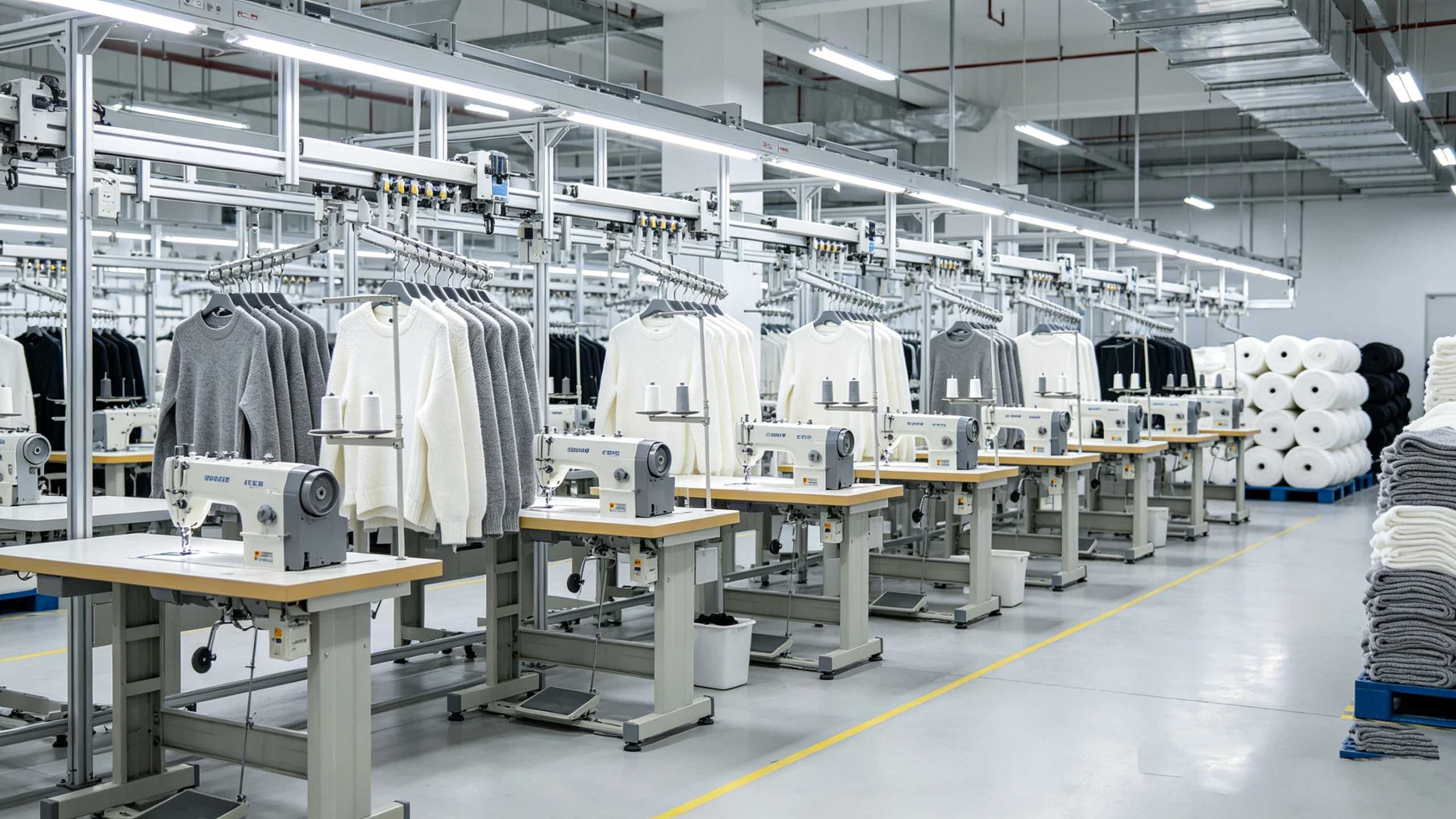
Walk into our factory floor on any given morning, and you will see the same scene: rolls of grey cloth being loaded onto automatic cutting tables, patterns being laid out with millimeter precision, and the first pieces of fabric beginning their journey through six distinct stages. At Tai’an Liyuan, we do not outsource. We do not fragment. Every step from raw grey cloth to packaged finished garment happens under one roof, managed by one team, tracked by one system.
The first stage is cutting. Our automatic cutting equipment handles large spreads of fabric with speed and accuracy that manual methods cannot match. This matters because the cut is where quality begins. A misaligned cut creates waste, delays, and inconsistencies that multiply down the line. By investing in automated cutting technology, we ensure that every panel — whether it is the front of a t-shirt or the sleeve of a sweater — starts its life exactly where it should.
From cutting, the pieces move to sewing. This is the heart of the factory. Multiple types of sewing machines line our production floor, each configured for specific stitches, fabrics, and garment types. The centerpiece of this stage is our automatic hanging production line system. Rather than moving garments in bundles from one workstation to the next, our overhead conveyor system transports individual pieces along the line. Workers receive each piece at the optimal height and position, reducing handling time and physical strain while increasing output consistency.
After sewing comes ironing. This stage does more than remove wrinkles. It sets the shape of the garment, activates finishes applied during fabric production, and creates the crisp, professional appearance that buyers expect. Our finishing equipment applies the correct temperature and pressure for each fabric type, ensuring that delicate knits are not damaged and heavier fabrics receive adequate heat.
Needle detecting and thread trimming follow. Every garment passes through needle detection machines calibrated to identify the smallest metal fragments. This is not optional. It is a non-negotiable safety standard, especially for garments destined for children’s wear, athletic use, or any market where consumer safety regulations are strict. Thread trimming ensures clean edges and a polished final appearance.
Quality control comes next. Our QC team inspects garments at multiple checkpoints, not just at the end. They check stitch density, seam alignment, measurement accuracy, fabric defects, and overall workmanship. Any piece that fails to meet the client’s approved sample standard is flagged, corrected, or remade. We do not ship “close enough.”
The final stage is packaging and incasement. Garments are folded, labeled, tagged, and packed according to each client’s specifications. Some orders require individual polybags. Others need carton packing with size breakdowns and barcode labeling. Our system handles these variations without confusion because every order is tracked from cutting to carton.
This full-flow model is not merely efficient. It is accountable. When a client asks why a measurement is slightly off, we can trace the issue back to the exact cutting table, the exact sewing station, and the exact operator. That traceability is what separates a factory from a production partner. At Tai’an Liyuan, we choose to be the latter.